UK Company vs Indian Subsidiary
August 18, 2026 · Nikita B · Company Incorporation, Company Registration
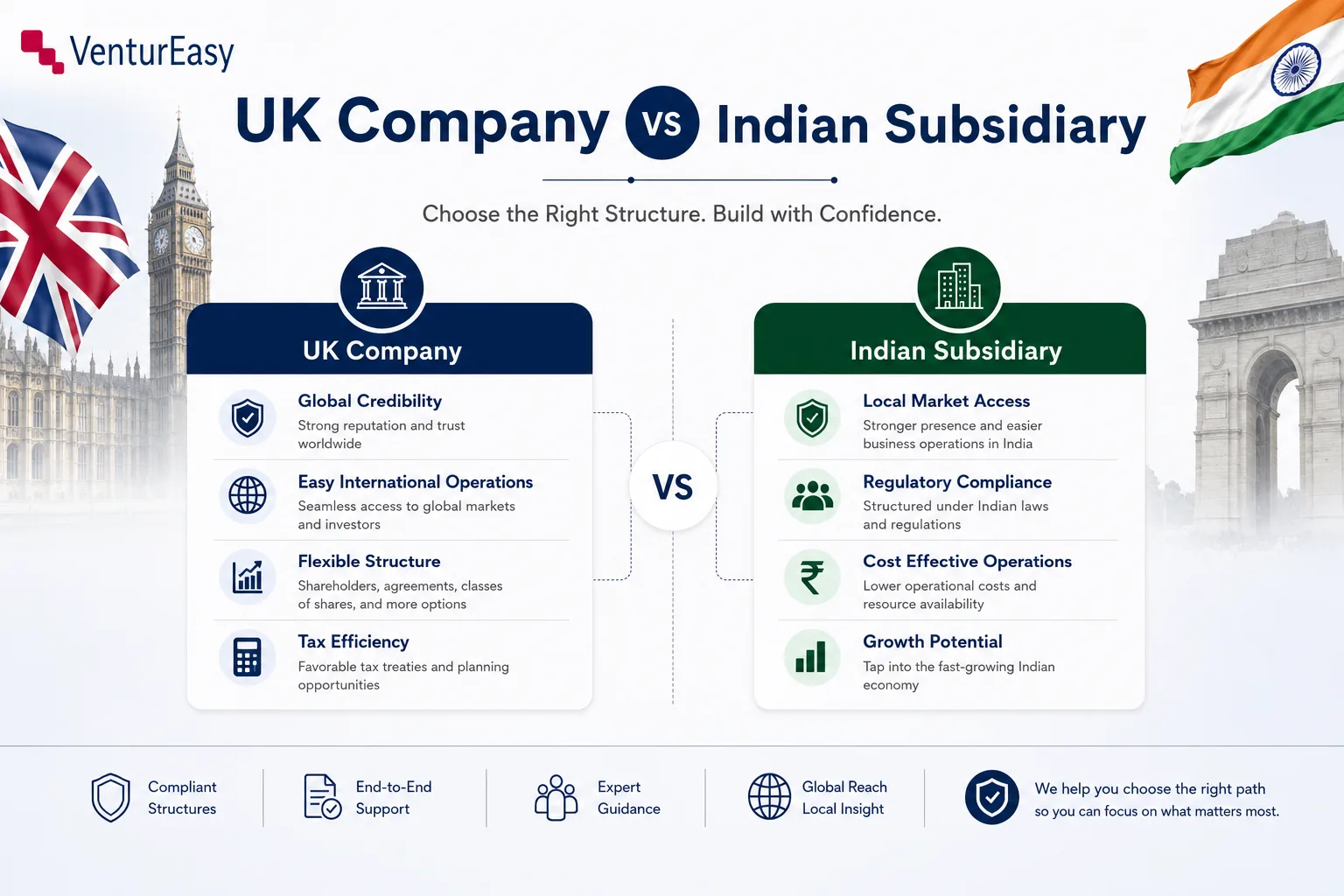
Among the many choices that UK firms have to make in order to get into the Indian market, choosing the right legal framework could be considered among the first things they should do. There are two main options for the firm in doing business through either the company currently existing in the UK or setting up a wholly owned subsidiary of the UK company.
The following are some of the key differences between a UK company and an Indian subsidiary.
What Are the Options for a UK Company Doing Business in India?
A British company cannot assume that the UK company of the business will be able to engage in all kinds of business activities in India without consideration for the Indian laws. The foreign business enterprise has the option to form subsidiaries, branches, liaison offices, or project offices, among others, based on the activities that it wishes to pursue.
Several firms that wish to undertake substantial business in India may form an Indian subsidiary company. As per the Indian government policy regarding FDI and FEMA, foreigners are able to carry out their business activities through the formation of an Indian company, including a wholly-owned subsidiary company.
Operating Through a UK Company
The Indian subsidiary can equally analyze the use of a foreign company organization in its business operations in India, provided the activities and regulations in this case allow such a move. This shall be important in a scenario where the Indian subsidiary in India operates on a small scale.
Activities and regulations should be examined first.
Setting Up an Indian Subsidiary
The Subsidiary Structure in India would involve setting up a company incorporation in India but owned by a foreign company, such as a UK-based company. The subsidiary will operate independently within the laws of India.
This arrangement may favor the UK firm wishing to establish itself in the country.
UK Company vs Indian Subsidiary: Key Differences
The most distinct thing about the two is the legal personality of both entities. A UK company refers to the entity that remains incorporated in the UK. However, an Indian subsidiary refers to a company incorporation in India.
The Indian subsidiary is able to maintain its bank accounts, make employment, enter into contracts, and conduct lawful business activities in India. However, a foreign company would have more restrictions due to the nature of the company as well as the business activities it can conduct in India.
Legal and Regulatory Considerations
All this will have to be looked at in addition to the issue of convenience in registration.
FDI laws in India for UK companies, FEMA laws, sectoral requirements, and company laws will have an effect on the type of structure that can be put in place.
The country allows foreign direct investment in numerous industries wherein foreign equity may even amount to 100 percent in most instances.
Hence, when a UK company wishes to form an Indian subsidiary, it will have to look at all the laws applicable to that particular industry before incorporating a company in India and investing there.
Tax Differences Between a UK Company and an Indian Subsidiary
Another significant criterion for comparing a UK company with an Indian subsidiary is that of taxation.
To register an Indian subsidiary, the company is expected to be a resident of India since it is an Indian company that meets the criteria for residence and will be subject to tax in India on its income. Liability to GST, withholding tax, transfer pricing tax, and other taxes would depend upon the specific facts and circumstances.
In case a UK company carries out any activity in India, then the Indian tax implications will vary according to the type of activity carried out by it. Matters such as permanent establishment, business income, withholding, and treaties would have to be considered.
The Indian-UK tax regime would become relevant in case there is any income, service charges, management fees, or any other cross-border transaction between the parent and the subsidiary.
Cost of Setting Up an Indian Subsidiary
However, subsidiary company registration in India is not only associated with the incorporation cost. The costs that the UK firm needs to apportion are:
Cost of government incorporation
Cost of digital signature and directors’ fees
Cost of incorporation services
Accounting and bookkeeping
Cost of taxes
Corporate compliance per annum
GST compliance if necessary
Payroll and staff management
Transfer pricing if necessary
Licensing and registration
Despite these costs being an additional administrative cost for the subsidiary firm in India, they are likely to be relatively insignificant as long as the firm intends to do business in India.
Advantages of an Indian Subsidiary for UK Companies
An Indian subsidiary of a UK company can offer several practical advantages.
Separate Legal Identity
The subsidiary is a separate entity from its parent based in the UK. This will make the operations of Indian entities distinct from those of the parent company, depending on the relevant laws.
Local Business Presence
Subsidiaries will be useful for giving more presence in dealing with the Indians as clients, suppliers, employees, and associates.
Hiring Employees
Indian companies could be helpful for foreign companies in terms of hiring Indian laborers because they would be offering them an Indian way of employing laborers.
Long-Term Scalability
It might work well for organizations that plan to put their money into building infrastructure, train teams, earn revenue from India, and grow their business.
Better Operational Flexibility
The commercial activities that a company from India can undertake depend on the sector and laws in which it operates.
Potential Challenges of an Indian Subsidiary
Subsidiary creation is followed by a never-ending chain of duties. These include maintaining books of accounts, annual report duties, tax issues, and regulation of companies.
The British parent company might also want to have a mechanism to handle its interactions with its subsidiary in India and all cross-border transactions.
What this means is that the compliance procedures for the subsidiary must be worked out right at the start and not after incorporation.
When Should a UK Company Consider an Indian Subsidiary?
There are several reasons for the existence of the Indian subsidiary in case the UK firm desires to:
Establish a presence in India
Recruit local people
Form an office or team
Conduct its operations in India
Have substantial financial interests
Generate income from India
Work in different regions of India
Carry out its own business operations in India
For those companies with limited and temporary presence, a different type of foreign enterprise would be better suited according to the range of activities allowed under Indian law.
How to Set Up an Indian Subsidiary for a UK Company
Incorporating a company in India would usually require good planning with regard to the ownership, directors, paperwork, and foreign investments.
The process would involve:
Selection of the kind of Indian business organization.
The selection of shareholders and directors.
Obtaining of the required Digital Signature Certificates and DIN.
Preparation of the papers for incorporation.
Application for incorporation to the Ministry of Corporate Affairs.
Receiving the documents of incorporation of the business and PAN/TAN.
Opening an Indian bank account.
Any filings relating to FDI/FEMA.
GST and other business registrations.
The requirements would depend on the form of ownership, the nature of the business conducted, and how the business was done.
Common Mistakes UK Companies Should Avoid
One of the common mistakes is the selection of the structure without analyzing the actual Indian operations of the company. The firm must first analyze if it requires manpower, office, local contracts, investments, and revenue.
Another common mistake relates to the concern for only incorporation costs. The costs incurred in accounting, tax, payroll, and corporate compliance may be higher than the cost of incorporation.
Another mistake that UK companies should avoid is seeing Indian compliance from the point of view of UK compliance.
UK Company vs Indian Subsidiary: Which Is Better?
One cannot make an absolute answer for all businesses.
The best option could be the setting up of an Indian subsidiary by a British firm seeking to set up a sustainable commercial entity in India, employing workers and investing money there.
The foreign enterprise form may be preferred when the business has limited or temporary activities, or activities that are allowed.
The appropriate answer must depend upon the goals of the business, its industry, ownership, investment size, revenue, and staffing.
Build Your India Expansion With VenturEasy
When comparing the legal setup of the UK company with an Indian subsidiary of foreign firms, it is not just the incorporation costs that need to be considered. All other aspects, such as legal setup, FDI, FEMA, taxation, staffing, accounting, and other compliance measures, need to be taken into account.
The VenturEasy team helps UK-based businesses to create a plan for incorporating a company in India, including business incorporation, compliance, accounting, taxation, and other business incorporation services. If you wish to take your business operations from the UK to India, then the right structure matters!
Frequently Asked Questions
About Nikita B
Nikita Bhatia is the co-founder of VenturEasy, an online platform for company registration, book-keeping, accounting, tax consultancy, and legal compliance in India. A Fellow Chartered Accountant (FCA) with over 14 years of experience and a Company Secretary by profession, she has wide experience in the fields of audit, accountancy, taxation, and corporate governance. For any questions/requirements, please email at [email protected]