Foreign Company Registration in India
Starts at $399
Professional Fees for Company Incorporation including Name Search and Reservation, MOA & AOA preparation, Incorporation Application, DIN, PAN, TAN, Assistance in opening bank accounts.
NOTE: DSC procurement and any Out-of-pocket expenses are billed based on actual costs.
* Prices are higher for Private Limited Company Registration in Kerala, Madhya Pradesh and Punjab on account of higher stamp duty.
Written & reviewed by Nikita Bhatia, FCA - Chartered Accountant (14+ years) & Company Secretary, Co-founder of VenturEasy
Last updated 21 August 2026
Have a Question?
Tell us a bit about what you need and we'll get back to you within 24 hours.
Registration of Foreign Company in India
Are you planning to expand your business and exploring options for Company Registration in India as a foreign entity? One of the most efficient and globally trusted structures for foreign companies is registering a Private Limited Company in India. Unlike structures such as proprietorship, partnership firm, or OPCS, foreign direct investment (FDI) is not only allowed in private limited companies, it is also allowed through the automatic route. This means that the process is streamlined and less time-consuming.
A private limited company also offers strong advantages, including limited liability protection, easy ownership transfer, high credibility, and the flexibility of a partnership combined with the stability of a corporate structure. This makes it the preferred choice for foreign businesses, startups, and investors looking to build a long-term presence in India.
At VenturEasy, we specialize in helping foreign nationals, NRIs, and overseas companies complete their Company Registration in India seamlessly. From drafting documents to compliance management, from obtaining approvals to assistance with opening a local bank account - we handle everything end-to-end so you can focus on building your business.
Documents required for Registration of Foreign Company in India
For Directors/Shareholders
- One Photograph
- Copy of Passport
- Copy of Address proof - Driving License/Voter ID
- Copy of Bank Statement/Mobile Phone/Landline Telephone Bill
- Copy of Business Visa and Proof of Stay in India
NOTE: All the above documents should be notarized by a Public Notary and Appostilled/Consularized by the Competent Authority of the foreign country.
For Company Address
- Proof of Registered Address – Sale Deed/Rental Agreement
- Copy of Utility bill - Electricity/Landline telephone/Gas Bill - not older than two months.
- No Objection Certificate for use of premises, if required
Choosing a Name for your Private Limited Company
Certain important points should be kept in mind when choosing a name for private limited company registration:
Tips for Choosing Your Company Name
- Make sure that the Company name is unique and does not resemble the name of any other existing Company or LLP.
- It is easier to obtain a name if it depicts the objects of your company.
- The name should not include any word which is a registered trademark or has been applied for Trademark registration.
Process of Foreign Company Registration in India
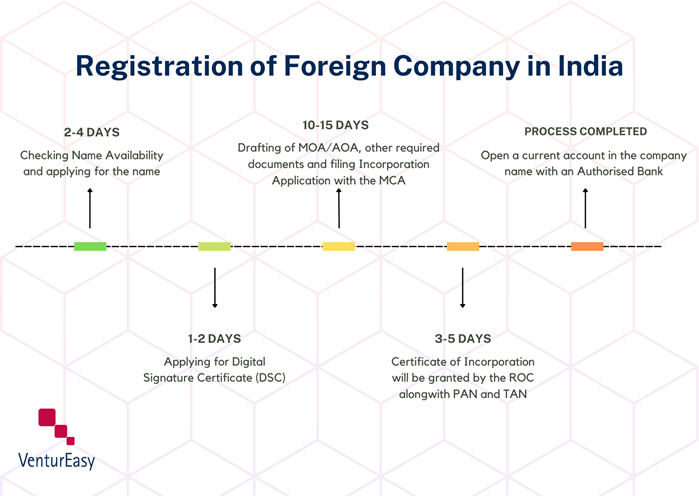
It usually takes 15-20 days to complete a Company Registration in India, subject to ROC processing time. VenturEasy makes the process simple and smooth for foreign businesses. Registering a foreign company in India follows an easy three-step process with expert assistance at every stage:
Watch: How foreign companies, foreign nationals & NRIs register a company in India
Name Approval
2-4 working days
Procurement of DSC
1-2 working days
Incorporation Application
10-15 working days
Step 1. Name Approval: The first step towards incorporation of foreign company in india is reserving the Company name. In case of a subsidiary company, it is permissible to use the same name as that of the foreign company with the addition of the word "India" to it. The name is approved, provided the same is not identical to existing entities or considered undesirable by law.
Step 2. Procurement of DSC: In parallel, the Digital Signature Certificate (DSC) will be procured for the proposed directors of the Company. This DSC is required to file the Incorporation application digitally and will also be used for future compliance reporting.
Step 3. Incorporation Application: This is the final step to the foreign company incorporation in India. It requires filing of the Memorandum and Articles of Association of the Company along with various other documents duly executed by the proposed directors and shareholders to the Ministry of Corporate Affairs.
List of Incorporation documents to be executed:
- Articles of Association
- Memorandum of Association
- Declaration by Directors in form DIR 2
- Declaration of Directors/Shareholders and Authorized Representative in Form INC 9
- PAN Undertaking from foreign company and directors
Generally, the incorporation documents are required to be self-attested by Indian Nationals. However, in case of Foreign Nationals, the process is as under:
If the documents are signed outside India, then the same have to be notarized by a Public notary of the residence country and consularized or apostilled by the competent authority, as the case may be.
If the documents are signed in India, then copy of Visa and stamped passport, proving his/her presence in India at the time of signing is required.
If the subscriber is a foreign entity, then the Incorporation documents should be signed by the representative of the foreign entity. An Authorization Letter duly stating the name of the Authorized Person and the number of shares subscribed should be notarized, consularized or apostilled, as the case may be in the home country of the subscriber company.
Once the Incorporation application is approved, the Registrar would issue a Certificate with a Corporate Identification Number (CIN). The PAN and TAN of the Company would also be allotted simultaneously.
Advantages of Foreign Company Registration in India
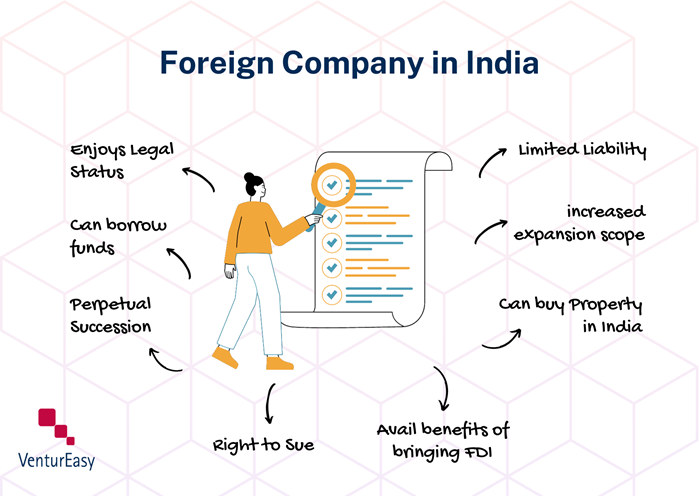
Separate Legal Entity
In India, a company is a legal entity and a juristic person. It has wide legal capacity and can even own property.
Limited Liability
The Directors or Shareholders of the company have no personal liabilities.
Easy Borrowing
Banks and VCs prefer to render large financial assistance to a company.
Perpetual Succession
Private limited companies enjoy business continuity because the company is its own legal entity.
Tax Advantages
A company opens the door to more tax-deductible costs and allowances redeemable against profits.
Increased Expansion Scope
India has a sizeable market that will enable foreign businesses to expand their revenues and effectiveness.
Dual Relationship
A person can at the same time be a shareholder, director, creditor and employee of the company.
Capacity to sue and be sued
A company in India being an independent legal entity can sue and also be sued in its own name.