Private Limited Company Registration
Private limited company registration is the widely preferred business structure for Indians as well as foreign nationals establishing business in India, as it provides limited liability protection to its shareholders and is highly credible. This structure offers a reliable and scalable framework supporting foreign direct investment for international businesses entering the Indian market.
Written & reviewed by Nikita Bhatia, FCA - Chartered Accountant (14+ years) & Company Secretary, Co-founder of VenturEasy
Last updated 26 August 2026
Have a Question?
Tell us a bit about what you need and we'll get back to you within 24 hours.
Private Limited Company Registration in India
A private limited company is a type of business entity that offers limited liability protection to its shareholders, while also providing the ability to raise capital through the issuance of shares. This makes it a popular choice for many entrepreneurs and small business owners.
When registering a private limited company, there are several steps that must be taken to ensure compliance with legal and regulatory requirements. These include obtaining Digital Signature Certificates and Director Identification Numbers, filing the incorporation documents with the Registrar of Companies, and obtaining various licenses and permits as required. Our team of experts has extensive experience in helping clients navigate the private limited company registration process. We provide comprehensive services that include everything from obtaining the necessary documentation to filing the incorporation papers. We also assist with the compliance requirements that arise post registration like maintaining records, filing returns, and statutory compliance.
We understand that starting a business can be a daunting and time-consuming task, which is why we strive to make the process as smooth and stress-free as possible. Our goal is to help our clients get their businesses up and running as quickly and efficiently as possible, so they can focus on what they do best - growing and managing their companies. If you're ready to take the next step and register your own private limited company, please reach out to us today. We'll be happy to answer any questions you may have, and provide you with a detailed quote for our services. Let us help you turn your business dreams into reality.
How can we register a company in India – Process of Company Registration in India
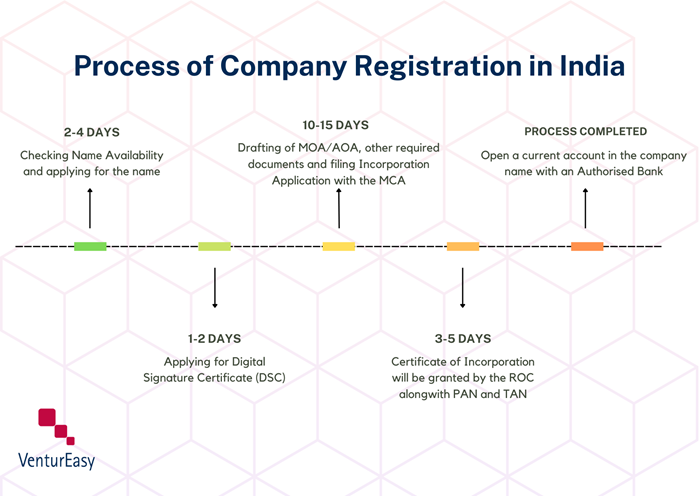
It usually takes 15-20 days to register a Private Limited Company in India, subject to ROC processing time. VenturEasy makes Private Limited Company Registration easy for you.
Name Approval
3-5 working days
Procurement of DSC
1-3 working days
Incorporation Application
10-15 working days
Documents required for Private Limited Company Registration
For Directors/Shareholders
- Passport Size Photograph
- Copy of PAN Card
- Copy of either Passport, Voter ID or Driving License
- Copy of Bank Statement or any Utility Bill in their address - not older than two months
- Copy of Aadhaar Card
For NRI or Foreign Directors and Shareholders
- Passport size Photograph
- Copy of Passport
- Copy of Driving License
- Bank Statement or any utility bill in the country of residence - not older than two months
Note: All the documents of the NRI/Foreign Directors should be notarized by a Public Notary and apostilled or consularized by the concerned authority in the country of residence
For Company Address
- Proof of Registered Address – Sale Deed/Rental Agreement
- Copy of Utility bill - Electricity/Landline telephone/Gas Bill - not older than two months.
- No Objection Certificate for use of premises, if required
Choosing a Name for your Private Limited Company
Certain important points should be kept in mind when choosing a name for private limited company registration:
Tips for Choosing Your Company Name
- Make sure that the Company name is unique and does not resemble the name of any other existing Company or LLP.
- It is easier to obtain a name if it depicts the objects of your company.
- The name should not include any word which is a registered trademark or has been applied for Trademark registration.
A Step-by-Step Guide to Company Registration in India
- Step 1. Name Approval: The first step towards company registration in india is reserving the Company name. The name is approved, provided the same is not identical to existing entities or considered undesirable by law.
- Step 2. Procurement of DSC: In parallel, the Digital Signature Certificate (DSC) will be procured for the proposed directors of the Company. This DSC is required to file the Incorporation application digitally and will also be used for future compliance reporting.
- Step 3. Incorporation Application: This is the final step to the company registration in India. It requires filing of the Memorandum and Articles of Association of the Company along with various other documents duly executed by the proposed directors and shareholders to the Ministry of Corporate Affairs.
List of Incorporation documents to be executed:
- Articles of Association
- Memorandum of Association
- Declaration by Directors in form DIR 2
- Declaration of Directors/Shareholders and Authorized Representative in Form INC 9
- PAN Undertaking from foreign company and directors
Once the Incorporation application is approved, the Registrar would issue a Certificate with a Corporate Identification Number (CIN). The PAN and TAN of the Company would also be allotted simultaneously.
For a more detailed walkthrough of eligibility, documents, and costs, see our complete guide to private limited company registration. If you're incorporating as a foreign company, foreign national, or NRI, our foreign company registration service covers the additional documentation involved.
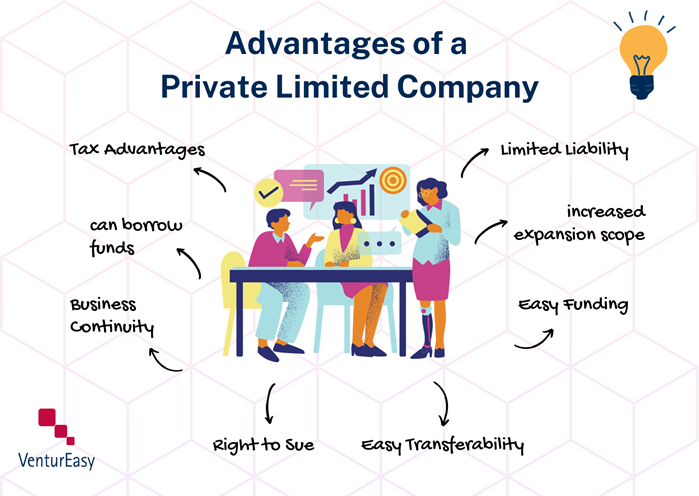
Advantages of a Private Limited Company
Legal Entity
A company is a legal entity and a juristic person. It has wide legal capacity and can own property.
Limited Liability
The Directors or Shareholders of the company have no personal liabilities.
Easy Funding
Banks and VCs prefer to render large financial assistance to a company.
Business Continuity
Private limited companies enjoy perpetual succession because the company is its own legal entity.
Tax Advantages
A company opens the door to more tax-deductible costs and allowances redeemable against profits.
Easy Transferability
Shares of a Company are easily and freely transferable.
Dual Relationship
A person can at the same time be a shareholder, director, creditor and employee of the company.
Capacity to sue and be sued
A company in India being an independent legal entity can sue and also be sued in its own name.
Comparing Private Limited Company, LLP and OPC
| Factors of Comparison | Private Limited Company | One Person Company | Limited Liability Partnership |
|---|---|---|---|
| Minimum Requirement | Members – 2 Directors – 2 |
Member – 1 Director – 1 Nominee of Sole Member – 1 |
Designated Partners – 2 |
| Minimum Capital | No minimum requirement | No minimum requirement | No minimum requirement |
| Regulator | Registrar of Companies | Registrar of Companies | Registrar of Companies |
| Compliance Requirements | Annual Return Filing Board Meetings & General Meetings |
Annual Return Filing No Board Meetings, if only one director No General Meetings |
Annual Return Filing |
| Taxation | Taxed at 30% | Taxed at 30% | Taxed at 30% |
| Credibility | High | Medium | Medium |
| Investor Preference | High | Low | Medium |
| Statutory Audit | Compulsory | Compulsory | If Contribution > Rs 25lacs or, Turnover > Rs. 40lacs |
| Conversion | Can be converted into LLP | Cannot be converted before 2 years | Cannot be directly converted into a Private Limited Company |
| Time Taken for Registration | 15 – 20 Days | 10 – 15 Days | 15 – 20 Days |
| Procedure | Obtain DSC (Digital Signature Certificate) INC-32 Incorporation Filing PAN, TAN Applications |
Obtain DSC (Digital Signature Certificate) MoA & AoA, INC-32 Incorporation Filing PAN, TAN Applications |
Obtain DSC (Digital Signature Certificate) Obtain DPIN (Designated Partner Identification Number) Name Approval Filing for Incorporation File LLP Agreement PAN, TAN Applications |
| Company Registration | OPC Registration | LLP Registration |