Company Incorporation in India: Complete Guide to Register Your Business Easily in 2026
September 13, 2026 · Nikita Bhatia · Company Incorporation
India added 131,275 new business entities between January and April 2026 alone, 85,560 of them Private Limited Companies, according to Ministry of Corporate Affairs data (SiliconIndia/Ebizfiling, August 2026). If you're one of the founders behind that number, or about to be, this guide covers company incorporation in india: what it means legally, which structure to pick, the step-by-step SPICe+ process, real cost expectations, and how long it realistically takes.
Key Takeaways
The government filing fee for incorporation is genuinely ₹0 for companies with up to ₹15 lakh in authorized capital, under a 2019 MCA rule. Stamp duty, professional fees, and DSC costs still apply, though, so the realistic all-in total is usually ₹7,000–₹25,000.
MCA does not publish an official incorporation-turnaround SLA; practitioners commonly report roughly 7-10 working days for an error-free filing, though this varies by state and case.
A Private Limited Company needs a minimum of 2 directors (at least 1 an Indian resident) and 2 shareholders.

What Is Company Incorporation?
Company incorporation is the legal process of registering a business under the Companies Act, 2013. Once complete, the business becomes a separate legal entity, distinct from its owners. It can then own property in its own name, enter contracts, open bank accounts, and be liable for its own debts.
Why Incorporate a Company in India?
Incorporating gives a business several concrete advantages over operating informally:
Legal recognition - the business is formally registered with the Ministry of Corporate Affairs.
Limited liability protection - owners aren't personally liable for the company's debts.
Business credibility - registered companies find it easier to win the trust of clients, vendors, and investors.
Easier access to funding - banks and investors generally prefer to deal with an incorporated entity.
Tax advantages - companies can access deductions and structuring options that aren't available to unincorporated businesses.
Types of Companies in India
Picking the right structure before you incorporate matters. It affects liability, compliance load, and how easily you can raise money later.
Private Limited Company
The most common structure for startups: needs a minimum of 2 directors and offers limited liability with relatively easy access to funding.
One Person Company (OPC)
Built for solo founders - a single person acts as both director and shareholder, while still getting limited liability.
Limited Liability Partnership (LLP)
A common choice for professional and services firms, with a lighter compliance load and flexible internal management.
Public Limited Company
Suited to larger businesses that plan to raise capital from the public.
Step-by-Step Company Incorporation Process
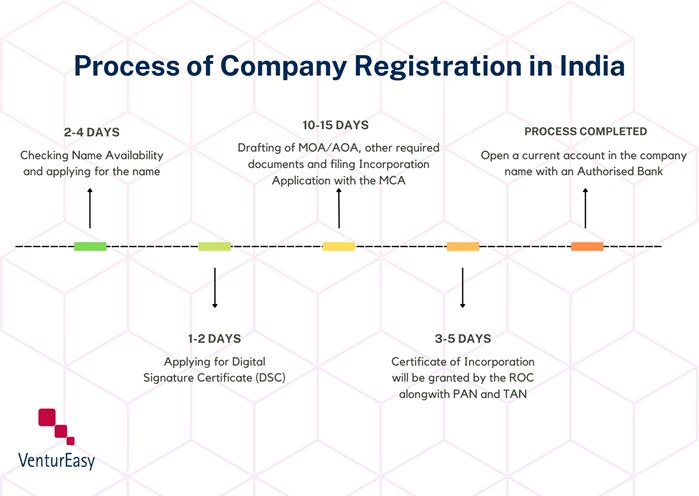
Step 1: Obtain Digital Signature Certificates (DSC)
Every proposed director needs a Digital Signature Certificate to sign incorporation documents online.
Step 2: Apply for Director Identification Numbers (DIN)
Each director needs a DIN, issued by the Ministry of Corporate Affairs. It's typically applied for as part of the SPICe+ filing itself, not as a separate prior step.
Step 3: Reserve the Company Name
Apply through the RUN (Reserve Unique Name) service, or as part of Part A of SPICe+, to reserve a unique company name.
Step 4: Prepare the MOA and AOA
Draft the Memorandum of Association and Articles of Association, which set out the company's objectives and internal governance rules.
Step 5: File the SPICe+ Form
Submit the incorporation application through SPICe+ (INC-32), MCA's integrated incorporation form, which bundles name reservation, incorporation, DIN allotment, and PAN/TAN application into a single filing.
Step 6: Receive PAN and TAN
PAN and TAN are issued automatically alongside incorporation through SPICe+, so no separate application is needed.
Step 7: Receive the Certificate of Incorporation
Once the Registrar of Companies approves the filing, it issues the Certificate of Incorporation, officially bringing the company into existence.
Documents Required for Company Incorporation
For Directors and Shareholders
PAN Card
Aadhaar Card
Address proof (bank statement, electricity bill, or telephone bill, not older than 2 months)
Passport-size photograph
For the Registered Office
Utility bill for the premises
Rent agreement, or ownership proof if self-owned
No-Objection Certificate (NOC) from the property owner
Cost of Company Incorporation in India (2026)
This is where a lot of guides get vague, or wrong. The actual government filing fee under SPICe+ is ₹0 for a company with authorized capital up to ₹15 lakh, under Rule 38(2) of the Companies (Incorporation) Rules, 2014, as amended by MCA notification G.S.R. 180(E), effective March 6, 2019. Above that threshold, government fees scale with authorized capital.
That doesn't mean incorporation is free, though. The realistic all-in cost most founders end up paying, based on aggregated 2026 registration-service pricing (not an official government figure), typically falls in the ₹7,000–₹25,000 range, made up of:
Stamp duty (varies by state and authorized capital)
Digital Signature Certificate (DSC) charges, per director
Professional/service fees for filing and documentation
How Long Does Company Incorporation Take?
MCA does not publish an official target turnaround time for SPICe+ filings. What practitioners commonly report, based on aggregated industry experience rather than a government SLA, is roughly 7-10 working days for an error-free filing. That's faster if the name is approved on the first attempt and documents are complete, and slower if there's a name rejection or a documentation gap. Treat any specific "X days" claim you see online, including this one, as an estimate, not a guarantee.
Common Mistakes to Avoid
Choosing a name too similar to an existing company or trademark
Submitting incomplete or mismatched documentation
Ignoring post-incorporation compliance requirements
Picking the wrong business structure for the long-term plan
Post-Incorporation Compliance
Incorporation is the starting point, not the finish line. After the Certificate of Incorporation is issued, a company needs to:
Open a company bank account
Appoint a Statutory Auditor
File annual returns with the Registrar of Companies
Maintain statutory registers and records
Hold the required Board and General Meetings
See our full breakdown of ongoing compliance requirements for a Private Limited Company for the complete list and filing deadlines.
Where India Stands on Ease of Doing Business
India doesn't currently hold a World Bank Ease of Doing Business rank. The report that produced that ranking was discontinued in 2021. India is scheduled for inclusion in the World Bank's new B-READY assessment framework in 2026, following a domestic reform push that has eliminated or simplified more than 47,000 compliance requirements since 2020, per the Department for Promotion of Industry and Internal Trade (PIB, February 2026).
Want the full walkthrough with all the supporting documentation and forms? See our complete company incorporation guide, or if you're a UK or US founder registering remotely, our guide to setting up a company in India as a foreign founder. For hands-on help, VenturEasy's registration service handles documentation and filing end to end. Get in touch with your requirements.
Frequently Asked Questions
About Nikita Bhatia
Nikita Bhatia is the co-founder of VenturEasy, an online platform for company registration, book-keeping, accounting, tax consultancy, and legal compliance in India. A Fellow Chartered Accountant (FCA) with over 14 years of experience and a Company Secretary by profession, she has wide experience in the fields of audit, accountancy, taxation, and corporate governance. For any questions/requirements, please email at [email protected]